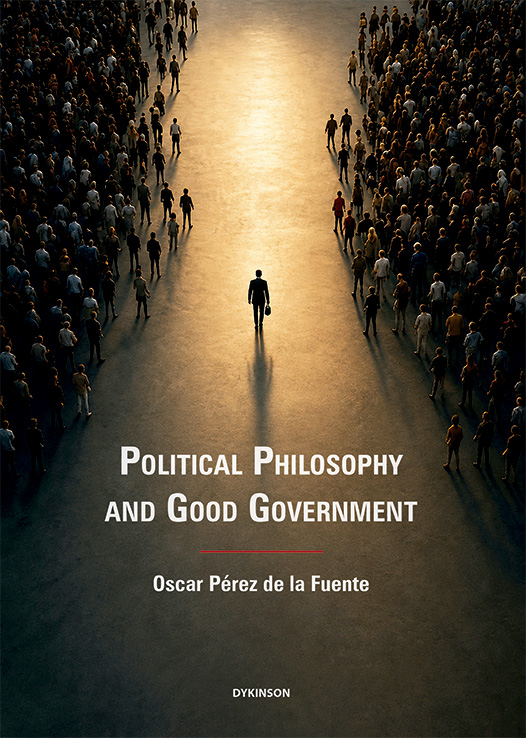


Political philosophy and good government
- ISBN: 9791370475697
- Editorial: Editorial Dykinson
- Fecha de la edición: 2026
- Lugar de la edición: Madrid. España
- Encuadernación: Rústica
- Medidas: 24 cm
- Nº Pág.: 389
- Idiomas: Inglés

Political Philosophy and Good Government brings together two fields that are too often kept apart: the grand tradition of political thought and the urgent practical question of how public power can be exercised with integrity. Structured across twenty thematic units, the book is divided into two complementary halves. The first twelve units set out the foundations of Political Philosophy: the nature of politics, the relationship between ethics and power, reason of state, the limits of State intervention, the Rule of Law, Theories of Justice, the grounds and limits of political obligation, democracy, cultural diversity and minority rights, public opinion and free speech, and global justice. These questions have shaped Western political thought from Plato and Aristotle through Hobbes, Locke, Rousseau, Kant and Mill to Rawls, Dworkin and their contemporaries. The second half turns to good government: to what goes wrong when power forgets its purpose. Units on corruption, ethics and deontology, corruption in public administration, judicial integrity, the relationship between politics and finance, clientelism, lobbying, democratic accountability and transparency complete the picture. The move from classical theory to contemporary pathology is deliberate. Corruption is not a marginal phenomenon; it is one of the defining challenges of contemporary democracy. Political Philosophy, the author argues, must provide the conceptual tools needed to understand it, name it and fight it.
Prologue
Unit 1: What is politics?
Unit 2: The relationship between ethics and politics
Unit 3: Reason of State
Unit 4: Limits of State intervention
Unit 5: Rule of Law and its evolution
Unit 6: Theories of Justice (I)
Unit 7: Theories of Justice (II)
Unit 8: Obedience and civil disobedience
Unit 9: Democracy
Unit 10: Cultural diversity and rights of minorities
Unit 11: Public opinion and free speech
Unit 12: Global justice
Unit 13: What is corruption?
Unit 14: Corruption, ethics, and deontology
Unit 15: Corruption in Public Administration
Unit 16: Judicial corruption
Unit 17: Politics and finance
Unit 18: Clientelism and lobbies
Unit 19: Democracy and accountability
Unit 20: Transparency