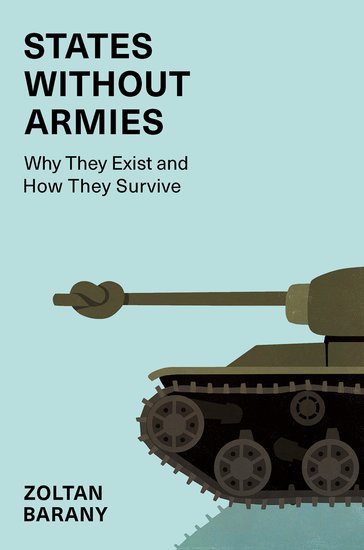


States without armies
why they exist and how they survive
- ISBN: 9780197679678
- Editorial: Oxford University Press
- Fecha de la edición: 2026
- Lugar de la edición: New York. Estados Unidos de Norteamérica
- Encuadernación: Cartoné
- Medidas: 24 cm
- Nº Pág.: 243
- Idiomas: Inglés

One of the fundamental assumptions regarding the modern state is that it must have the capacity to defend itself from external enemies. Yet, there are twenty-one countries today-one ninth of the United Nations' membership-that do not maintain standing armies.
What historical contexts, geographical endowments or socio-economic conditions allow or even encourage a state to go without an army? When does a country decide not to have an army, and under what circumstances is the issue even discussed? What kind of security provisions or guarantees, if any, do countries that consider demilitarization seek prior to making such a decision? And what are the disadvantages and benefits of not fielding a standing army? Zoltan Barany addresses all of these questions and more with three core arguments. First, he shows that the question of whether to create a new army or disband an extant force tends to arise at critical historical junctures for a nation. This may follow a civil war, a military coup, or an economic collapse. Second, virtually all of the states that do not maintain standing armies enjoy formal or informal security arrangements that provide explicit guarantees or implicit assurances that sovereignty will be safeguarded. Third, demilitarized states are more democratic and generally better off - and often far better off - in terms of political stability and nearly every measurable variable of socio-economic well-being than similar countries that maintain standing armies. States without Armies sheds new and counterintuitive light on the role of force in the international state system.
1:Demilitarized States
2:Why They Exist
3:How They Survive (I): The International System, Alliances, and Conflict Management
4:How They Survive (II): Security Sector and Assistance
Conclusion: Benefits, Comparisons, Prospects